
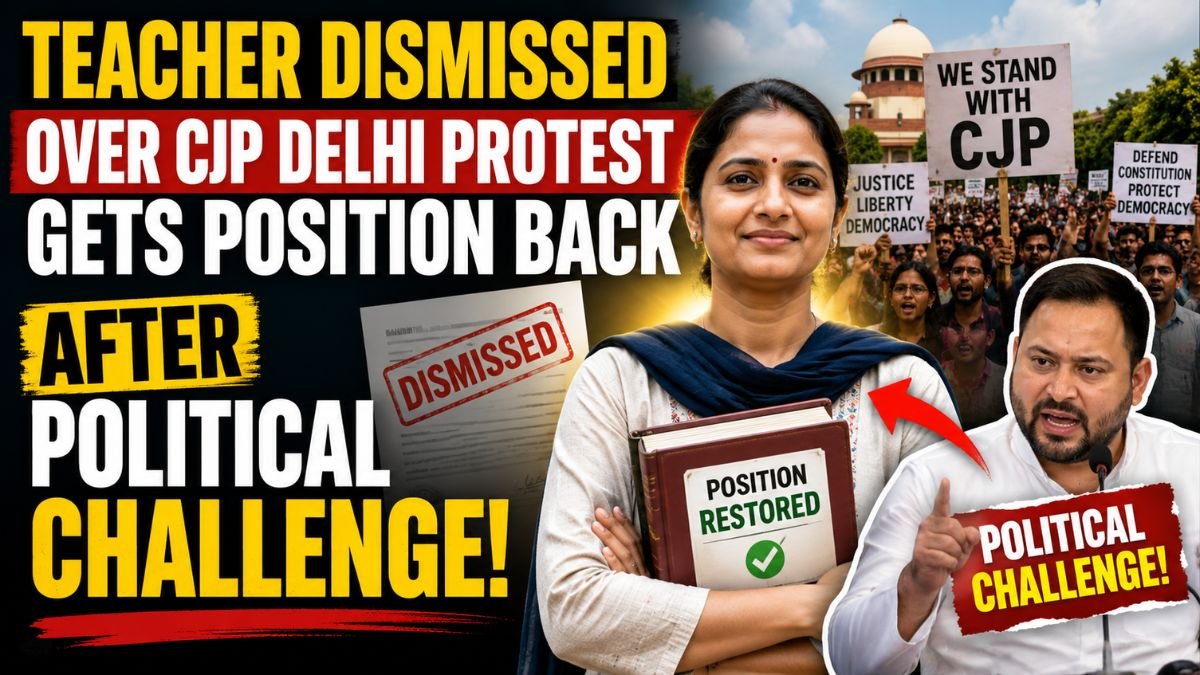
In a democratic society, every citizen is entitled to express their opinion and participate in peaceful protests. However, the situation becomes highly sensitive when this right begins to impact an employee’s job. A recent case involved a teacher who was allegedly dismissed for participating in a protest in Delhi organised by the CJP (Citizens for Justice and Peace). This incident sparked a debate among the academic community, political organisations, and civil rights advocates.
Now, there has been a new development in the case. According to reports, the teacher has been reinstated. It is understood that the administration reconsidered its decision after a political organisation raised its voice against the dismissal and challenged the matter publicly.
What was the case all about?
According to reports, the teacher in question had participated in a protest held in Delhi. The protest focused on social and political issues and saw the participation of various civil society organisations and activists. Following the protest, the teacher’s employer took action against them and terminated their employment.
News of the dismissal immediately raised questions regarding the decision. Supporters argued that the teacher had participated in a democratic event in a personal capacity and that this had no direct bearing on their professional obligations. Conversely, others held the view that institutions may have their own rules and codes of conduct that all employees are required to follow.
Political intervention changed the situation.
The case garnered further attention when a political organisation launched a campaign against the dismissal, terming it unjust. Leaders of the organisation claimed that firing an individual solely for participating in a peaceful protest violated freedom of expression and democratic values.
The issue was raised on various platforms. Many people also voiced their support for the teacher on social media. Gradually, the matter evolved from a local dispute into a subject of widespread public discussion. Amidst mounting pressure and public debate, the concerned parties began a review of the case.
Why is the decision to reinstate the teacher significant?
Many view the news of the teacher regaining their job as a significant development. This is not merely a matter of one individual’s employment; it raises broader questions—should an employee be penalised for their personal political or social views.
How can a balance be struck between an employee’s personal freedom and institutional regulations?
Experts believe that each such case requires an individual assessment. If an employee’s activities do not directly impact their workplace, taking harsh action solely based on the expression of personal views can spark controversy. Conversely, institutions argue that they have the right to safeguard their reputation and uphold their rules.
Growing Debate in the Education Sector
This incident has intensified discussions within the education sector. Many teachers and education experts argue that teachers are not merely employees who deliver a curriculum but are also conscious citizens of society. Therefore, they should have the right to participate in social and democratic processes.
However, some have also noted that teachers should exercise caution when participating in public activities to avoid casting doubt on their professional impartiality. Thus, this case has reignited the debate regarding the balance between rights and responsibilities.
The Role of Social Media and Public Support
In the modern era, social media has the power to elevate any issue to a national level. This was evident in the present case as well. Following the news of the teacher’s dismissal, widespread discussion erupted on social media platforms. Numerous social activists, educators, and ordinary citizens voiced their support and demanded an impartial enquiry into the matter.
Public support and ongoing debate kept the issue in the headlines. Experts believe this pressure compelled the concerned parties to review the case, ultimately paving the way for a resolution.
Renewed Discussion on Democratic Rights
This incident once again brings to the fore the question of what the limits of democratic rights should be. In any democracy, citizens are granted the freedom to engage in peaceful protest and express their opinions. However, complex situations can arise when such rights clash with workplace rules.
Legal experts believe that a balanced approach is essential in such cases; neither should employees’ rights be disregarded, nor should institutional policies be completely ignored.
Conclusion
The news regarding the reinstatement of a teacher—who had been dismissed after participating in a protest in Delhi—has once again sparked a national debate on democratic rights, freedom of expression, and job security. This case is not limited to a single teacher; rather, it highlights broader questions concerning the relationship between civil rights and institutional regulations in a modern democratic society.
For now, his supporters view the reinstatement of his teaching job as a positive outcome. At the same time, this incident could serve as a significant precedent for future cases where a balance needs to be struck between personal freedom and professional responsibilities.
FAQs
Q1. Why was the teacher dismissed?
A. The teacher was reportedly dismissed after participating in a CJP-related protest in Delhi, which led to controversy and public debate.
Q2. How did the teacher get the job back?
A. According to reports, the dismissal was challenged by a political group, prompting a review that eventually resulted in the teacher’s reinstatement.
Q3. Why has this case attracted attention?
A. The case has sparked discussions about employee rights, freedom of expression, and the balance between personal activism and workplace policies.
