
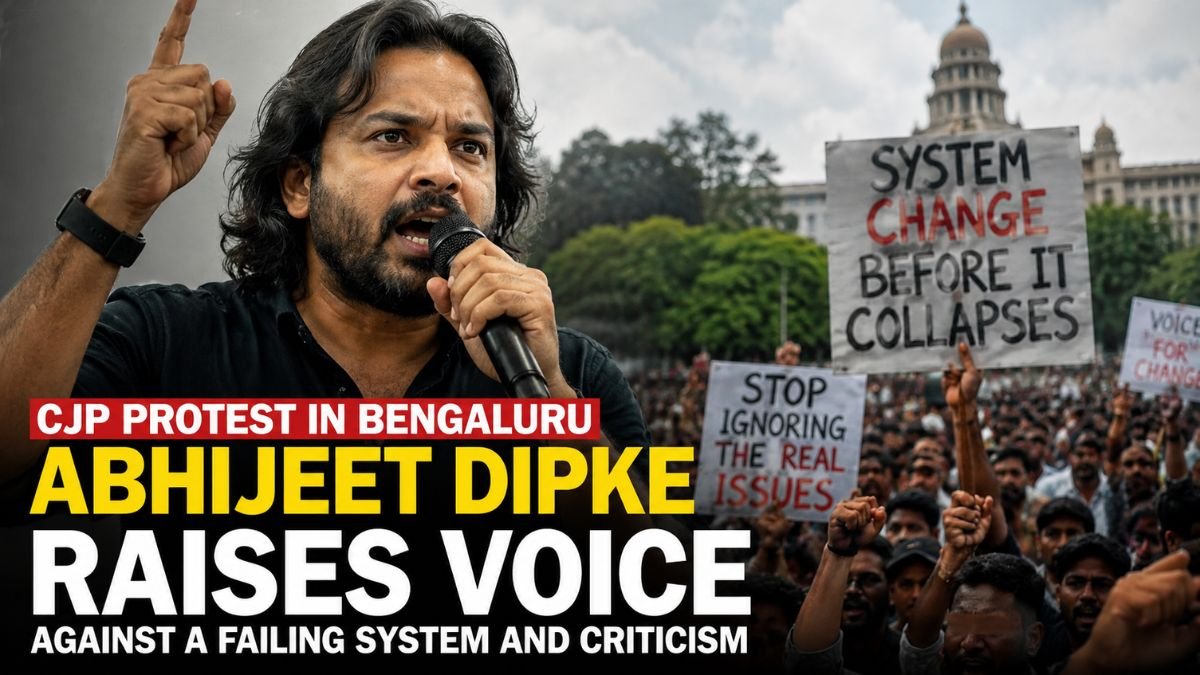
The CJP protest in Bengaluru has once again sparked a conversation about ongoing societal issues, civil rights, and systemic flaws. During the protest, many individuals raised their voices to draw attention to problems that are often overlooked. Amidst this, a statement by Abhijeet Dipke garnered significant attention; he expressed concern over the fact that those who expose systemic shortcomings often face criticism and opposition.
The primary objective of the protest was not merely to dissent, but to bring to the fore questions that demand answers from both society and the system. When an individual draws attention to a problem, the aim is usually to move towards reform. However, such individuals are often viewed negatively, and attempts are frequently made to silence them.
Abhijeet Dipke’s Statement and the Questions Raised
While speaking at the protest, Abhijeet Dipke noted that people often face criticism when they attempt to reveal the reality of a broken system. His statement highlights the fact that raising one’s voice to bring about societal change is no easy task.
He questioned the mindset that targets the very people who highlight problems. Asking questions and demanding answers is a vital component of any democratic society. If people do not discuss issues, the prospects for reform diminish significantly.
Why is Discussing Systemic Flaws Important?
The system of any country or society becomes robust only when it possesses the capacity to acknowledge and rectify its errors. Exposing flaws within the system is not an act of hostility against any individual or institution; rather, it reflects a hope for a better system.
Ordinary people often encounter problems in their daily lives that do not receive adequate attention. When an individual raises these issues publicly, they become a voice for many others. This is precisely why open discussion on social issues and the peaceful expression of views are considered essential.
Dissent, Criticism, and Freedom of Expression
The events surrounding the CJP protest raise a significant question: does every individual in society enjoy sufficient freedom to express their opinion? While it is natural to hold differing views on any issue, maintaining mutual respect and dialogue amidst disagreement is equally essential.
Criticism is an integral part of democracy; however, its purpose should be the exchange of ideas rather than the silencing of voices. The potential for positive societal change grows only when people can express themselves without fear.
Hopes for a Better Future
The protest in Bengaluru conveyed the message that awareness and dialogue regarding civic issues are vital. Abhijeet Dipke’s remarks drew attention to the importance of asking questions and ensuring accountability to bring about systemic improvements.
The hallmark of a robust society is the effort to understand and resolve problems rather than concealing them. The CJP protest has sparked a conversation in this very direction, prompting people to reflect on crucial themes such as the system, rights, and responsibility.
Conclusion
The CJP protest in Bengaluru sort of brought things to the front about the worries Abhijeet Dipke raised, regarding the difficulties people face when they try to question a system that seems to be failing. His comments mirror the irritation of those who think that raising a voice for transparency , accountability ,and justice frequently invites criticism instead. This protest underlines how open dialogue matters , along with responsible institutions and the need to safeguard the perspectives of people who lift genuine concerns. A healthy society, depends on the ability to talk through problems and cooperate toward real improvements.
FAQs
Q1. What was the CJP Protest in Bengaluru about?
A. The CJP Protest in Bengaluru focused on raising concerns about system issues, accountability, and citizens’ rights.
Q2. Who is Abhijeet Dipke and what did he say?
A. Abhijeet Dipke spoke about the challenges faced by people who highlight problems and criticize failures in the system.
Q3. Why did the protest gain attention?
A. The protest gained attention because it sparked discussions about freedom of expression, criticism, and the need for improvements in the system.
