
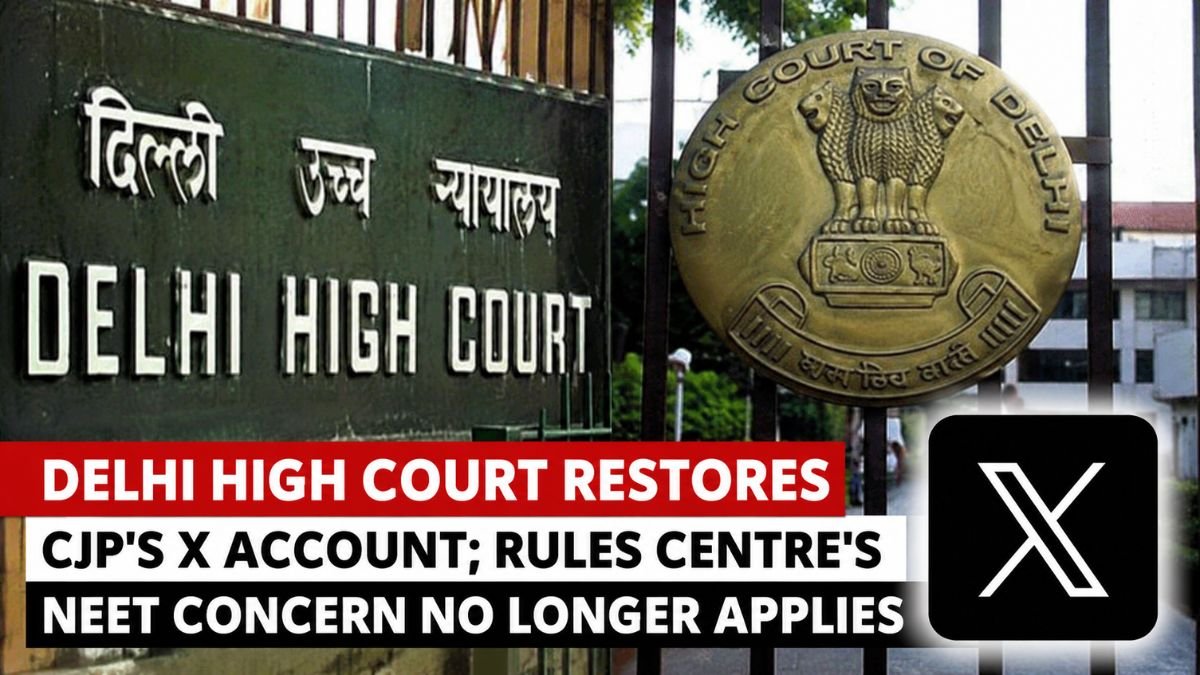
In the digital age, social media has evolved beyond a mere medium for sharing ideas; it has become a crucial platform for shaping public opinion, driving social campaigns, and fostering democratic dialogue. Consequently, the suspension of an individual’s or organisation’s social media account is not viewed merely as a technical measure but is directly linked to issues of freedom of expression and access to information.
Against this backdrop, a recent Delhi High Court ruling—ordering the restoration of the X (formerly Twitter) account of ‘Citizens for Justice and Peace’ (CJP)—has garnered significant attention. During the proceedings, the court observed that the concerns previously raised by the central government regarding the chaos surrounding the NEET examination were no longer relevant. This decision is considered significant in terms of digital rights, judicial balance, and freedom of expression.
What was the case about?
The issue arose when the social organisation ‘Citizens for Justice and Peace’ (CJP) alleged that its X account had been suspended, thereby preventing it from disseminating its views, social campaigns, and information of public interest to the masses. The organisation maintained that social media served as a primary channel for engaging with the public and argued that restricting the account without adequate justification infringed upon its constitutional rights.
What did the Delhi High Court say?
During the hearing, the Delhi High Court clarified that any action taken on a digital platform must be fair, balanced, and commensurate with the prevailing circumstances. The court indicated that if the grounds for a restriction cease to exist over time, continuing that restriction indefinitely cannot be considered justifiable.
Based on this reasoning, the court directed the restoration of CJP’s X account. It further stated that the concerns previously expressed by the central government regarding disorder during the NEET examination are no longer relevant in the current circumstances. This judicial perspective underscores the principle that administrative decisions must align with evolving circumstances.
The Importance of Social Media and Freedom of Expression
Today, social media platforms have become an integral part of democratic society. News, social campaigns, issues of public interest, and citizens’ opinions now frequently emerge through digital channels. Consequently, the suspension of an organisation’s social media account is not merely a technical issue; it impacts the organisation’s ability to communicate and reach its audience.
The Indian Constitution grants citizens the right to freedom of expression. While this right is not absolute—and reasonable restrictions may be imposed by law—the judiciary consistently ensures that such restrictions are necessary, fair, and proportionate to the circumstances. This is why courts place special emphasis on transparency and balance in matters concerning digital rights.
How Did the NEET Controversy Relate to This Case?
NEET is one of the country’s most significant medical entrance examinations. Any irregularity, misinformation, or rumour during the exam can affect millions of students and their families. For this reason, the government and relevant agencies exercise heightened vigilance regarding the dissemination of information during the examination period.
In this instance, too, the central government had cited circumstances related to NEET. However, the court held that the specific situation had passed and that previously expressed concerns could not justify maintaining a restriction indefinitely. Many legal experts view this observation as highlighting the need for the periodic review of administrative decisions.
The Role and Digital Presence of CJP
Citizens for Justice and Peace (CJP) has long been active on various issues concerning civil rights, social justice, and constitutional values. The organisation shares information about its campaigns, legal initiatives, and social activities primarily through digital platforms.
For such organisations, social media serves not merely as a medium for publicity but as an effective tool for engaging in dialogue with citizens. Therefore, the restoration of the X account is also being viewed as the restoration of the organisation’s digital reach.
The Judiciary’s Balanced Approach
This Delhi High Court ruling has once again clarified that the judiciary does not merely interpret the law but also assesses changing circumstances. In this case, the court did not state that the government lacks the right to raise security concerns; rather, it indicated that grounds cited in the past should be reviewed when circumstances change.
This approach is considered crucial for maintaining balance within a democratic system. It also conveys the message that administrative decisions are not immutable and are subject to judicial review when necessary.
Responsibility of Digital Platforms
Today, platforms like X, Facebook, Instagram, and other social media sites have become major arenas for public discourse. Consequently, these platforms bear the responsibility of enforcing their rules transparently and providing clear reasons for any actions taken.
Experts believe that in the future, it will be essential to establish better coordination, clear guidelines, and accountability mechanisms between social media companies and government agencies to ensure a balance between freedom of expression and the public interest.
Broad Impact of the Ruling
The Delhi High Court’s decision is not viewed as being limited solely to CJP; many experts working on digital rights see it as a significant precedent for future cases. The ruling serves as a reminder that any restriction must be commensurate with the prevailing circumstances and that a review is necessary if the original grounds for the restriction cease to exist.
Furthermore, the decision reassures citizens and organisations that they can approach the judiciary if they believe their rights have been unfairly infringed upon.
Conclusion
The Delhi High Court’s decision to restore the CJP’s X account—accompanied by the observation that the central government’s concerns regarding the NEET-related chaos are no longer relevant—underscores the importance of judicial balance and digital rights within Indian democracy. The ruling highlights the necessity of periodically reviewing administrative decisions and establishes that restrictions cannot be maintained indefinitely based on outdated grounds.
FAQs
Q1. Why did the Delhi High Court restore CJP’s X account?
A. The court ordered the restoration after ruling that the earlier grounds for restricting the account were no longer applicable.
Q2. What did the court say about the Centre’s NEET concern?
A. The Delhi High Court observed that the Centre’s concern over NEET-related chaos was no longer relevant.
Q3. Why is this ruling important?
A. It highlights the importance of proportional restrictions and freedom of expression on digital platforms.
