
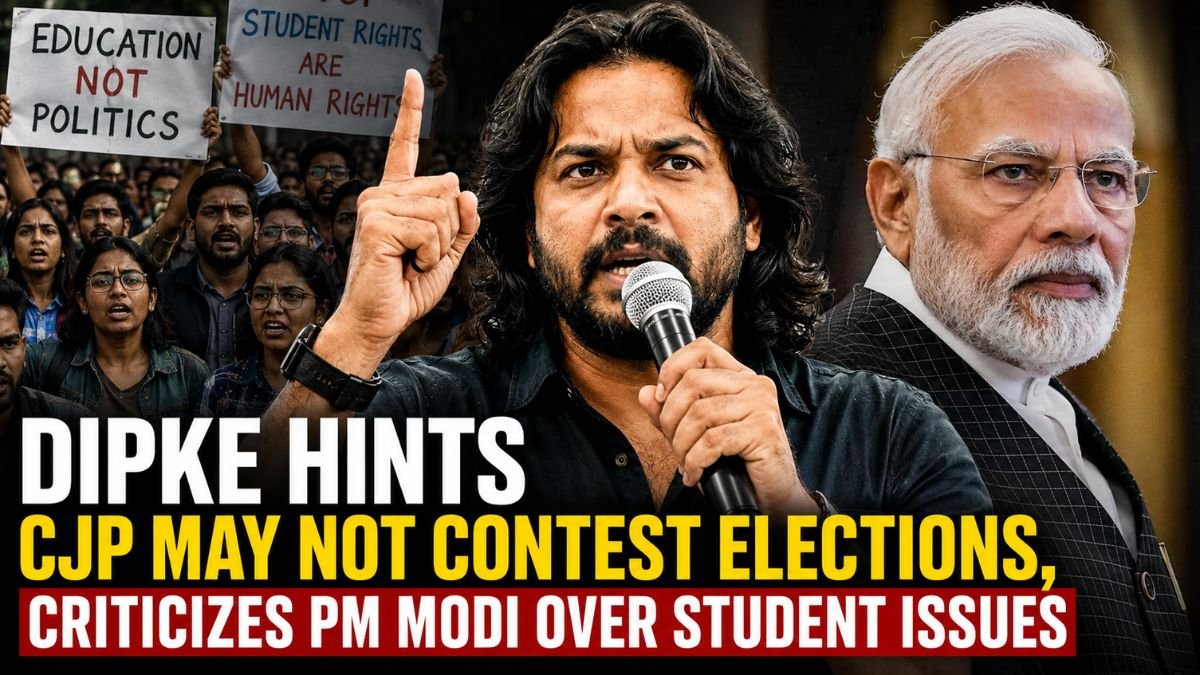
Discussions regarding the CJP’s stance on the upcoming elections have intensified in political circles recently. Dipke has hinted that the CJP might not participate in the upcoming elections. This statement has sparked various speculations within the political landscape. Supporters and political analysts are closely watching the CJP’s future strategy and whether it will indeed stay away from the electoral fray.
Dipke’s statement has ignited a fresh debate regarding the CJP’s political role. While some view the announcement as a strategic move, others suggest the decision might have been taken with the organization’s future plans in mind. In electoral politics, a major leader’s decision to either enter the fray or step aside carries significant weight; hence, this indication is considered crucial.
Targeting PM Modi over student issues
Dipke has also raised questions directed at Prime Minister Narendra Modi concerning issues affecting students. He alleged that the government has failed to engage in adequate dialogue regarding the problems and concerns faced by students. Issues related to education, employment, and the youth have always been central to politics, and Dipke’s statement places these very topics at the forefront.
Students form the foundation of any nation’s future. Their struggles, aspirations, and demands play a pivotal role in political discourse. Dipke emphasizes the need for the government to establish greater dialogue with the youth by reaching out to students and understanding their issues.
The growing role of youth in politics
The role of the youth demographic in India is steadily expanding. A large number of young people are voicing their opinions on matters concerning education, employment, and their future. Political parties, too, are prioritizing the youth in their agendas, recognizing that young voters can significantly influence election outcomes.
Following Dipke’s statement, the question arises whether student-related issues will emerge as a major political theme in the upcoming elections. The expectations of the youth are evolving; they are demanding concrete policies and solutions rather than mere promises.
New Debates in the Political Climate
Uncertainty regarding the CJP contesting elections and Dipke’s remarks concerning PM Modi have further heated the political atmosphere. More reactions to this issue are likely to emerge in the coming days. Political parties and leaders are viewing the entire matter from their respective perspectives.
In any democratic system, it is natural for debates to arise regarding the decisions of leaders and issues concerning the public. Elections are not merely a means to gain power; they also serve as an opportunity to bring the public’s problems and expectations to the forefront.
Conclusion
Dipke’s statement has sparked a new political discourse regarding the CJP’s electoral future and issues concerning students. While questions persist about the CJP’s participation in the elections, the debate over the government’s role in addressing student issues has intensified. Time will tell how significant the political impact of these issues proves to be and in which direction electoral strategies will evolve.
FAQs
Q1. What did Dipke say about CJP’s election plans?
A. Dipke hinted that CJP may not contest the upcoming elections, creating discussions about the party’s future political strategy.
Q2. Why did Dipke criticize PM Modi?
A. Dipke criticized PM Modi over concerns related to student issues and claimed that more attention and communication with students are needed.
Q3. Why are student issues becoming important in politics?
A. Student concerns related to education, employment, and opportunities often influence political discussions because young people play an important role in society.
Q4. Will CJP definitely skip the elections?
A. No official confirmation has been given. Dipke’s statement was an indication, and the final decision depends on CJP’s future announcement.
Q5. What impact can this statement have on politics?
A. The statement may increase debate around election strategies, youth issues, and how political leaders connect with students.
