
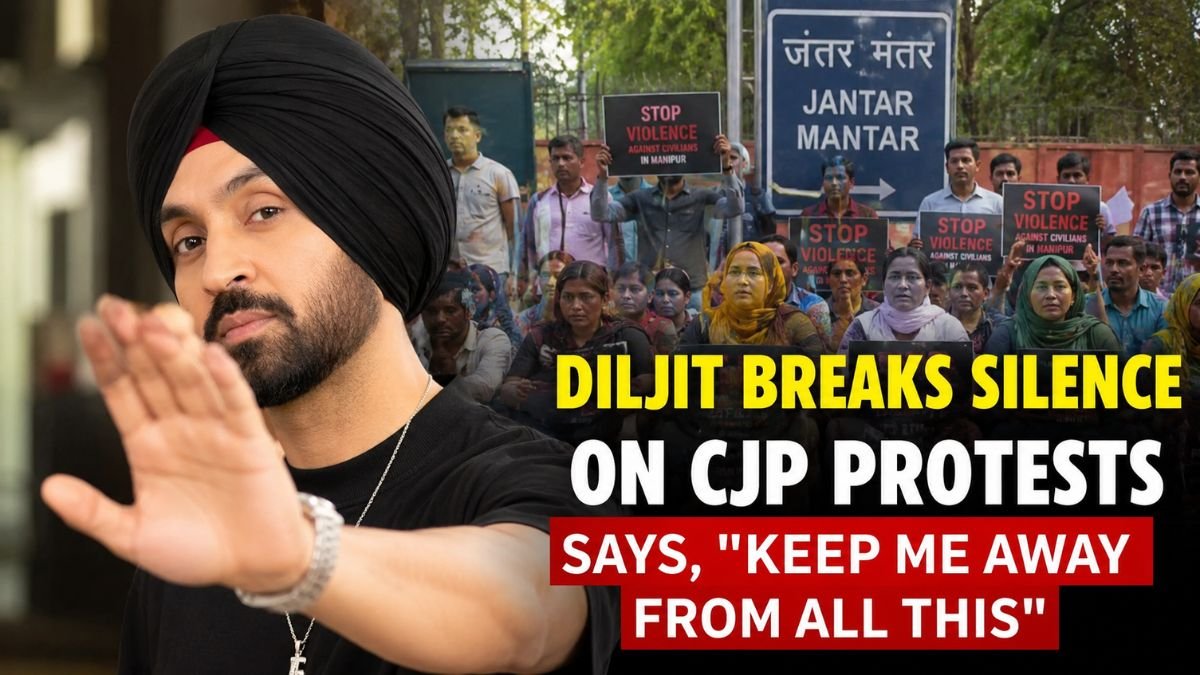
Diljit, a popular Punjabi singer and actor who has carved a distinct niche for himself globally, recently responded to the ongoing CJP (Collective Justice Platform) protest at Delhi’s Jantar Mantar. He stated unequivocally, “Keep me out of all this; I am an artist.” His statement has sparked widespread discussion across social media, the entertainment industry, and political circles.
While some view it as an artist’s personal opinion and an attempt to remain neutral, others see it through the lens of the responsibility borne by a public figure. However, Diljit’s message was clear: he wishes to distance himself from political controversies and movements, prioritising the entertainment of people through music, acting, and art.
Why did Diljit’s statement become a topic of discussion?
Diljit’s statement came at a time when the CJP protest at Jantar Mantar is a subject of national debate. The protest is generating constant discussion on social media, and many public figures are being asked to weigh in on the issue. When questioned about the matter, Diljit gave a brief yet clear response, asking to be kept away from these controversies because he identifies primarily as an artist.
His statement drew attention partly because of his immense popularity—not just in India but internationally. Consequently, any public comment he makes tends to attract significant media attention.
“I am an artist” – How is the statement being interpreted?
The most significant part of Diljit’s statement was, “I am an artist.” This single sentence has elicited various interpretations. Many believe he wanted to clarify that his role is to entertain people through art, rather than taking sides in political or social movements.
Meanwhile, some analysts observe that while artists in the public eye are often expected to respond to such issues, every individual has the right to choose which topics to address and which to avoid. From this perspective, Diljit’s statement reflects his personal preference and professional boundaries.
Mixed Reactions on Social Media
Following Diljit’s remarks, social media platforms saw a flood of reactions. His fans argued that an artist has every right to focus on their craft and is not obliged to respond to every social or political issue.
On the other hand, some believed that when an individual can reach millions of people, their views inevitably impact society; consequently, the public takes the comments of public figures seriously. However, the prevailing sentiment in most reactions was that artists should have the freedom to either express their opinions or remain silent.
Significance of Jantar Mantar and Ongoing Protests
Delhi’s Jantar Mantar has long been a key hub for peaceful protests. Social organisations, students, civic groups, and other bodies from across the country frequently gather there to demonstrate for their causes. The CJP protest is viewed as part of this ongoing tradition of activism surrounding various issues.
During such movements, media attention often turns to celebrities with widespread popularity. This is why Diljit was also asked for his reaction on the matter.
Growing Public Expectations of Artists
In today’s digital age, there is an expectation for celebrities—such as film stars, singers, and athletes—to weigh in on almost every major social or political issue. Social media has significantly intensified this pressure compared to the past. Often, if an artist chooses to remain silent, that silence itself becomes a topic of discussion.
Experts believe that in any democratic society, artists—like any other citizen—should have the freedom to choose whether or not to express their opinions. Speaking out on an issue or maintaining distance from it can both be matters of personal choice.
Diljit’s Public Image
Diljit Dosanjh is primarily known as a singer, actor, and successful entertainer. He has carved a distinct niche for himself not only in Punjabi music and cinema but also in Hindi films and on international platforms. His events draw large crowds of young people, and his popularity continues to rise. For this reason, none of his public statements remain confined to the entertainment world; instead, they become subjects of broader social discourse. However, Diljit has clarified on several occasions that his primary focus remains on his art and his connection with the audience.
Strategy to Steer Clear of Controversies
Many artists in the entertainment industry often avoid commenting on controversial or sensitive issues. One reason for this is that their fans come from diverse social, political, and cultural backgrounds. Consequently, many artists prefer to keep their professional lives separate from controversies.
Diljit’s recent statement is also seen as reflecting this mindset. Instead of taking a side or expressing opposition, he chose to distance himself from the entire controversy, making his message both clear and concise.
What Might Happen Next?
Discussions surrounding this statement by Diljit are likely to continue in the coming days. People will continue to share their perspectives on social media, while the entertainment and news sectors may also analyse the remark.
However, it is also possible that Diljit will refrain from making further comments on the matter, choosing instead to focus entirely on his music, films, and upcoming projects. His fans, too, would likely prefer that he continues to entertain audiences through his art.
Conclusion
Diljit’s statement—”Keep me out of all this; I am an artist”—has reignited the debate over whether public figures should express their opinions on every social and political issue. While many believe that artists influence society, it is equally important to respect an individual’s freedom to choose whether to speak out or remain silent.
For now, Diljit has made it clear that he does not wish to be associated with the CJP’s protest at Jantar Mantar; his priority is simply to connect with people through art, music, and acting. It will be interesting to see how the public discourse evolves, but one thing is certain: this remark by Diljit is likely to remain a topic of discussion for some time.
FAQs
Q1. What did Diljit say about the CJP protests?
A. Diljit said, “Keep me away from all this, I’m an artist,” distancing himself from the protests.
Q2. Where are the CJP protests taking place?
A. The protests are being held at Jantar Mantar in New Delhi, a common venue for public demonstrations.
Q3. Why is Diljit’s statement making headlines?
A. His remarks have sparked widespread discussion because he chose to stay neutral and emphasized his identity as an artist rather than commenting on the protest itself.
