
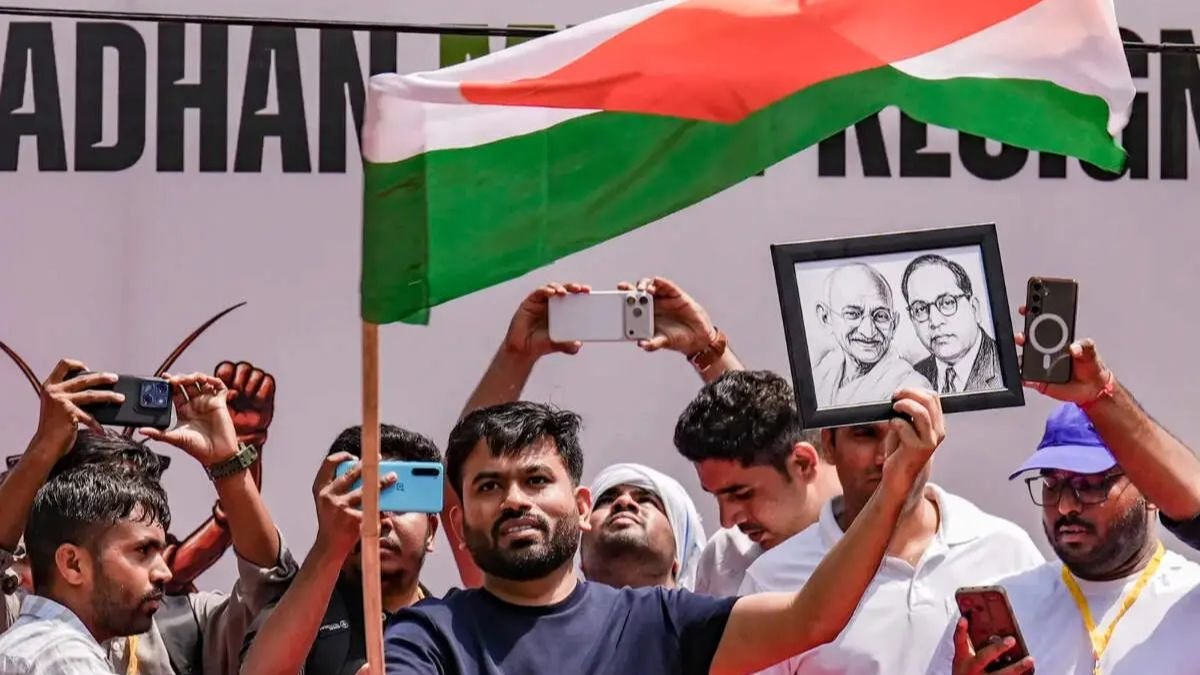
The ongoing protests regarding student issues and government policies continue to dominate public discourse. During the CJP protest, Dipke accused the central government of adopting an indifferent attitude toward the issue of student deaths. Protesters argue that there is an urgent need to seriously address student safety, their grievances, and their demands. Meanwhile, Wangchuk’s hunger strike has entered its second day, garnering further support for the movement.
This entire sequence of events has evolved beyond a mere protest; it has transformed into a broader debate concerning the education system, the voices of students, and government accountability. Protesters believe that since the youth form the foundation of the nation’s future, their struggles and problems should not be ignored. The CJP protest continues to gain momentum with this very sentiment at its core.
Dipke Levels Serious Allegations Against the Center
During the CJP protest, Dipke questioned the central government’s approach, stating that the government ought to demonstrate greater sensitivity regarding grave matters such as student deaths. He alleged that the manner in which student grievances are being treated suggests their voices are not being accorded sufficient importance.
Dipke’s statement has sparked intense discussion across political and social spheres. Many emphasize that issues concerning students should not be viewed merely as administrative matters but must be understood from a human perspective. Given that stress, pressure, and anxiety about the future are already significant challenges in student life, the responsibility of institutions and governments becomes all the more critical.
Issue of Student Deaths Becomes the Focal Point of the Movement
Questions surrounding student deaths constitute the primary driver of this protest. Protesters maintain that many tragic incidents could be averted if students received timely assistance, a better environment, and necessary support. Their objective is not merely to protest but to advocate for a system where students have safe and effective avenues to voice their concerns.
Issues such as the mental well-being, pressure, and safety of students in educational institutions have been subjects of ongoing discussion for some time. The CJP protest has once again brought these issues into the public discourse. Protesters are demanding a serious investigation into these matters and concrete steps to prevent such incidents in the future.
Wangchuk’s Hunger Strike Enters Day Two
Amidst this movement, Wangchuk’s hunger strike has entered its second day. The hunger strike is being viewed as a peaceful form of protest aimed at drawing the government’s attention to critical issues. This move by Wangchuk has garnered significant public attention.
Throughout the hunger strike, supporters have been consistently voicing their demands. They argue that when problems cannot be resolved through conventional means, conveying their concerns to the government via peaceful protest becomes essential. Wangchuk’s fast has given a new dimension to the movement and raised public awareness regarding the issue.
Protesters’ Demands and Expectations from the Government
The primary demand of those participating in the CJP protest is that issues and cases involving student problems and deaths be treated with the seriousness they deserve. They maintain that mere statements will not solve the problem; instead, there is a need for change at the grassroots level.
Protesters seek the establishment of better support systems for students, a robust grievance redressal mechanism, and an environment in educational institutions where students can share their concerns without fear. They believe that the government and institutions must collaborate to strengthen the confidence of the youth.
The Government’s Crucial Role Amidst Growing Debate
As the protest gains momentum, public attention is also focused on the role of the central government. In any democratic system, the right to protest and express one’s views is considered vital. In such situations, dialogue between the government and the protesters can pave the way for a resolution.
Issues concerning students are not limited to education alone; they are deeply linked to the future of society and the nation. Therefore, both sensitivity and dialogue are essential in addressing these matters. If all stakeholders work together towards finding a solution, long-standing problems can be mitigated.
The Voice of the Youth and Social Responsibility
The CJP protest has once again demonstrated the pivotal role that youth and students play in the nation’s social discourse. When students raise their voices regarding their grievances, it is not merely a matter of personal hardship; it also presents an opportunity to improve the system as a whole.
Society, too, bears the responsibility of understanding the challenges faced by students and contributing to the creation of a positive environment for them. Education is not confined to textbooks and examinations; the safety, dignity, and mental well-being of students are integral components of it.
Conclusion: Hope for a Resolution Amidst the Movement
The allegations leveled against the central government by Dipke during the CJP protest, combined with Wangchuk’s ongoing fast—now in its second day—have once again brought student issues to the forefront of national conversation. The protesters are demanding serious consideration of the issues surrounding student deaths and the challenges they face.
In the coming days, it will be crucial to observe how the dialogue between the government and the protesters unfolds. The ultimate objective of any movement should be a resolution, and for this, dialogue, responsibility, and sensitivity are essential steps. Students are the future of the nation; therefore, listening to their voices and ensuring their safety is the responsibility of society as a whole.
FAQs
Q1. What is the CJP Protest about?
A. The CJP Protest focuses on student deaths, safety concerns, and demands for government action.
Q2. What did Dipke criticize the Centre for?
A. Dipke criticized the Centre over what was described as a lack of response toward student deaths and related concerns.
Q3. What is the status of Wangchuk’s fast?
A. Wangchuk’s fast has entered its second day as part of the ongoing protest.
