
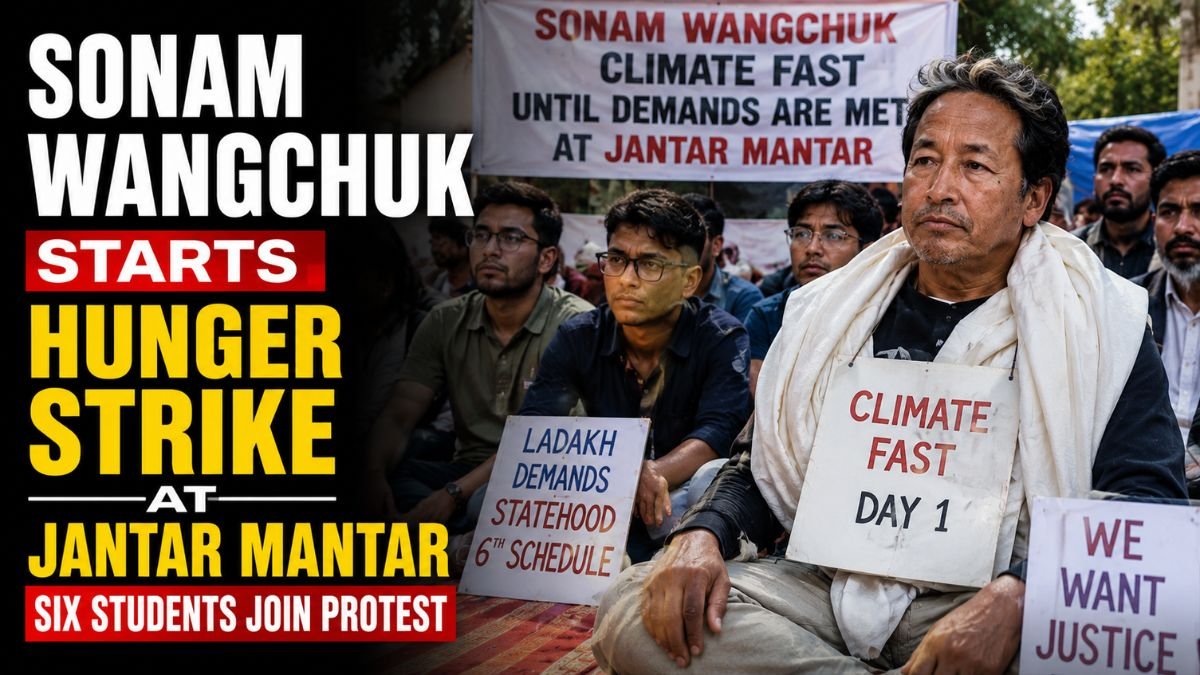
Sonam Wangchuk—the renowned education reformer, engineer, and social activist from Ladakh—has once again steered his movement in a new direction by launching a hunger strike at Jantar Mantar in New Delhi. This move has captured the attention of not only Ladakh but the entire nation. He has been joined in this fast by six students who have raised their voices in support of environmental conservation, Ladakh’s constitutional rights, and the demands of the local people. What began as a peaceful and democratic movement has now become a topic of national discussion. People believe this is not merely an individual’s protest but an effort to draw attention to issues that have long been ignored.
Another Major Movement Begins at Jantar Mantar
Jantar Mantar in New Delhi has long been a key hub for democratic protests. Various organizations and social activists from across the country have held peaceful demonstrations here to press for their demands. Sonam Wangchuk, too, launched his movement from this very location. He stated that his objective is not to seek political gain but to draw the attention of the government and society to critical issues concerning Ladakh’s future.
As the hunger strike commenced, a large number of supporters, students, and representatives from social organizations were present. People peacefully demonstrated their solidarity and reiterated their resolve to keep the movement non-violent.
Movement Gains New Momentum with the Participation of Six Students
The fact that six students have joined Sonam Wangchuk in the hunger strike is considered a significant aspect of the movement. These students state that they are raising their voices not only for Ladakh but also for the future of coming generations and for environmental conservation. They believe that if attention is not paid to natural resources and the concerns of local communities today, it could lead to serious consequences in the future.
The participation of students also demonstrates the growing awareness among the youth regarding these issues. He believes in voicing concerns through democratic means and bringing about change via peaceful protest. This approach has garnered the movement not only moral backing but also widespread public support.
What are Sonam Wangchuk’s key demands?
Sonam Wangchuk has long been advocating for Ladakh’s environment, cultural identity, and the rights of its local people. He maintains that the Himalayan region is rapidly facing the impacts of climate change; if effective measures are not taken in time, the consequences will affect not just Ladakh but the entire country.
His key demands include constitutional safeguards for Ladakh, environmental protection, the participation of local communities, and transparency in development projects. He believes that striking a balance between development and environmental conservation is crucial. He advocates for prioritizing the views of local people during policymaking to ensure the preservation of the region’s natural and cultural heritage.
The peaceful nature of the movement draws attention.
Sonam Wangchuk has always advocated for expressing views through non-violent and constitutional means. During the hunger strike at Jantar Mantar, he has urged his supporters to maintain peace and respect the law. No aggressive activity has been observed during the movement, making it clear that the protest’s sole objective is to convey demands to the government democratically.
This style of peaceful protest is resonating with many. Social activists note that dialogue and peaceful protest are citizens’ rights in a democracy, and such movements spark broad discussions on critical issues.
Support is pouring in from across the country.
Since the hunger strike began, people from various states have expressed their support for Sonam Wangchuk via social media and other channels. Environmental activists, student organizations, academics, and numerous social groups are closely monitoring the movement. Messages and images related to the protest are being rapidly shared on social media platforms, bringing the issue into the national spotlight. However, some believe that a solution should be reached through dialogue between the government and the protesters. Experts state that dialogue is the most effective approach in such sensitive matters and that both sides should take positive initiatives.
All eyes are on the government’s response.
Now that the hunger strike has begun, everyone is watching for the government’s likely response. Typically, following such protests, the concerned departments review the situation and explore possibilities for dialogue. If the government initiates a dialogue with the protesters, it could pave the way for discussions on various pending issues.
For the time being, the administration has put necessary arrangements in place to maintain law and order. Adequate security measures have been implemented at the protest site to ensure the agitation continues peacefully and to prevent any untoward incidents.
The debate on balancing environment and development
Sonam Wangchuk’s movement is not viewed as being limited to Ladakh alone; rather, it is strengthening the nationwide discourse on environmental conservation and sustainable development. Experts emphasize the necessity of rigorously assessing environmental impacts when implementing development projects in Himalayan regions. Failure to utilize natural resources in a balanced manner could exacerbate future problems such as water scarcity, biodiversity loss, and climate change.
For this reason, Wangchuk has consistently stressed the importance of ensuring local community participation in development plans and prioritizing environmental conservation above all else. His message is considered relevant not just to one region, but to the entire country.
What might happen next?
If the movement is prolonged, the likelihood of dialogue between the government and the protesters may increase. Political analysts believe that, within a democratic framework, finding a solution through dialogue is the most appropriate course of action. Meanwhile, supporters maintain that the movement will continue until positive steps are taken regarding their key demands.
In the coming days, the extent to which students, social organizations, and ordinary citizens remain engaged with this movement will be crucial. Everyone will also be awaiting an official statement or initiative from the government.
Conclusion
The hunger strike initiated by Sonam Wangchuk at Jantar Mantar has once again brought issues concerning Ladakh, environmental conservation, and constitutional rights to the forefront of national discussion. The participation of six students in this fast demonstrates that the younger generation also views these matters seriously and is prepared to voice its concerns through democratic means. For now, the nation is watching closely to see how the dialogue between the government and the protesters unfolds. If both sides choose the path of constructive dialogue, it could prove to be a significant step—not only for Ladakh but also for the tradition of democratic discourse.
FAQs
Q1. Why has Sonam Wangchuk started a hunger strike?
A. He has begun the hunger strike to press for his demands related to Ladakh’s constitutional safeguards, environmental protection, and local rights.
Q2. Where is the hunger strike taking place?
A. The hunger strike is being held at Jantar Mantar in New Delhi, a well-known venue for peaceful public protests.
Q3. Who has joined Sonam Wangchuk in the protest?
A. Six students have joined Sonam Wangchuk’s hunger strike in support of his movement and its key demands.
