
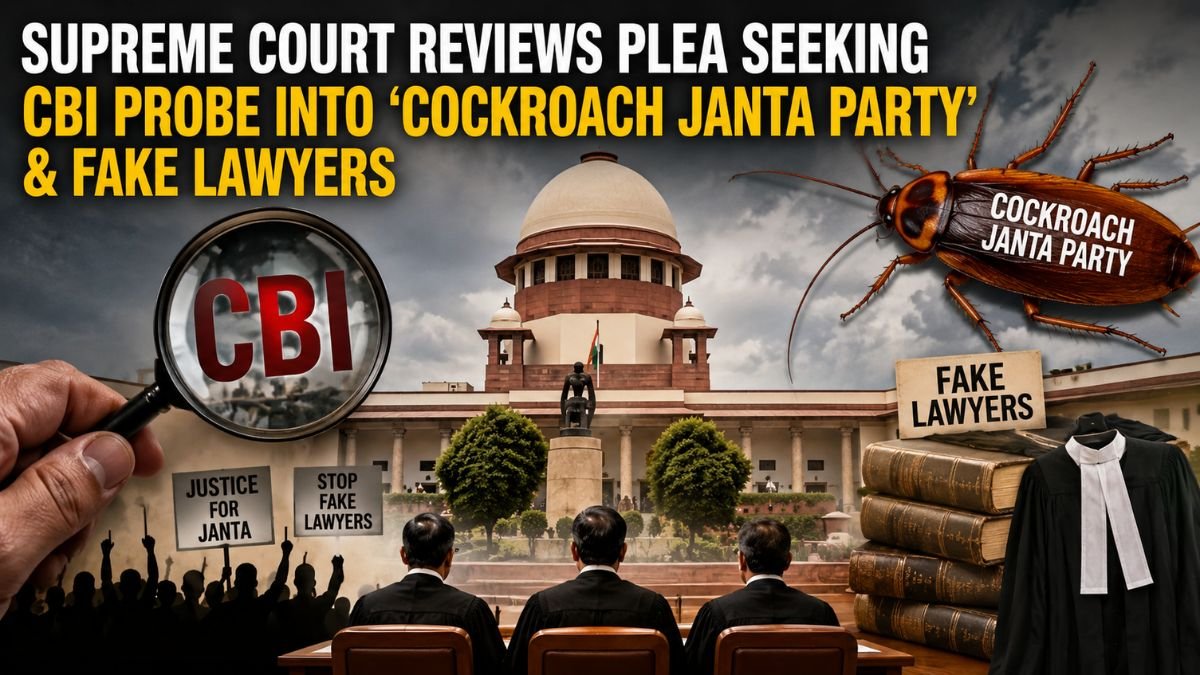
India’s judicial system once again found itself at the center of national attention after the Supreme Court agreed to hear a plea demanding a Central Bureau of Investigation (CBI) inquiry into the alleged operations of the so-called “Cockroach Janta Party” and the activities of fake advocates reportedly connected to the matter. The petition has triggered widespread debate across legal and political circles, with many questioning how individuals without proper legal qualifications could allegedly operate within sensitive judicial environments. The case has also intensified conversations around accountability, transparency, and the urgent need for reforms in India’s legal ecosystem.
According to the plea submitted before the apex court, serious allegations have been raised regarding fraudulent legal representation, misuse of judicial procedures, and suspicious organizational activities connected to the controversial group. Petitioners have argued that the issue goes beyond isolated incidents and may point toward a larger network operating under the guise of legal and political activism. The Supreme Court’s decision to review the matter has therefore been viewed as a significant development, especially at a time when public trust in institutions remains a sensitive issue.
Allegations of Fake Advocates Raise Serious Questions
One of the most alarming aspects of the plea involves allegations that several individuals posing as advocates may have appeared in courts and participated in legal proceedings without valid credentials. If proven true, such claims could expose serious loopholes in the verification systems used within parts of the legal profession. Legal experts have expressed concern that fake lawyers not only undermine the credibility of the judiciary but also place innocent litigants at risk by mishandling sensitive legal matters.
The petition reportedly highlights instances where individuals allegedly used forged enrollment certificates, fake bar registrations, or misleading professional identities to gain access to court proceedings. Such accusations have sparked concern among members of the legal fraternity, many of whom believe that stronger background checks and stricter disciplinary mechanisms are urgently required. Senior advocates and retired judicial officers have repeatedly emphasized that the legal profession depends heavily on ethics, authenticity, and public confidence. Any breach in those principles can damage the integrity of the justice delivery system.
The controversy has also drawn attention to the role of bar councils and local legal associations in verifying professional credentials. Critics argue that while technology has modernized several sectors, parts of the legal system still rely on outdated verification procedures that can be manipulated. As a result, the demand for digital databases, biometric verification, and centralized advocate records has gained momentum following the Supreme Court hearing.
Demand for a CBI Investigation Intensifies
The petitioners have specifically requested a CBI probe, arguing that the allegations involve multiple jurisdictions and potentially influential individuals. They claim that only an independent central agency possesses the authority and resources necessary to uncover the complete truth behind the alleged network. The plea reportedly points toward possible financial irregularities, misuse of political influence, and coordinated fraudulent activities that may require deeper forensic investigation.
Supporters of the CBI inquiry believe that the matter cannot be treated as an ordinary legal dispute because of its potential implications for both governance and judicial credibility. They argue that a transparent and impartial investigation would help restore public confidence while ensuring that those responsible are held accountable under the law. On the other hand, some observers caution that sensationalism surrounding the case should not overshadow the principle of due process. They stress that allegations alone should not be treated as proof until verified through proper legal investigation.
The Supreme Court’s observations during the hearing are being closely monitored, as any direction from the apex court could influence the future course of the investigation. Legal analysts believe that if the court decides to seek detailed reports from authorities or allows further examination of the allegations, the case may develop into a major legal and political controversy in the coming months.
Political Reactions and Public Attention
As expected, the case has generated intense political reactions. Opposition groups have used the controversy to criticize systemic failures, while supporters of certain political factions have described the allegations as politically motivated attempts to damage reputations. Social media platforms have also witnessed heated debates, with hashtags related to fake advocates and judicial accountability trending among users discussing the case.
Public interest in the controversy has grown rapidly because it combines several sensitive themes, including politics, law, fraud, and institutional trust. Many citizens have expressed shock over the possibility that unauthorized individuals could allegedly function within legal spaces that are expected to maintain strict professional standards. The issue has also reignited broader concerns regarding corruption, misuse of influence, and the effectiveness of regulatory bodies in monitoring professional conduct.
Political commentators believe the matter could become even more controversial if further investigations reveal connections between legal fraud and organized networks. Some analysts argue that the case highlights the urgent need for institutional reforms rather than temporary outrage. They suggest that regardless of political affiliations, strengthening judicial transparency and advocate verification systems should become a national priority.
Legal Experts Call for Structural Reforms
Several legal scholars and retired judges have used the controversy to highlight long-standing weaknesses within India’s legal administration framework. According to experts, the case demonstrates the importance of maintaining accurate records of licensed advocates and implementing strict monitoring systems across courts. Many have suggested creating a unified national database accessible to courts, police authorities, and bar councils to prevent unauthorized individuals from misrepresenting themselves as legal professionals.
There are also calls for stricter penalties against those found guilty of practicing law fraudulently. Experts argue that fake legal representation can destroy lives, especially in criminal, financial, or family disputes where legal outcomes directly affect ordinary citizens. Victims who unknowingly hire unqualified individuals may lose valuable time, money, and legal protection.
Additionally, legal professionals have emphasized the need for regular audits of advocate registrations and court entry permissions. With digital infrastructure expanding rapidly across India, many believe technology-driven reforms could significantly reduce the risk of impersonation and document forgery in the future.
Conclusion
The Supreme Court’s review of the plea seeking a CBI investigation into the alleged operations of the “Cockroach Janta Party” and fake advocates has opened a fresh chapter in the national conversation surrounding judicial integrity and accountability. While the allegations remain subject to investigation and legal scrutiny, the controversy has already exposed growing concerns about transparency within legal and institutional systems.
As the case progresses, public attention is expected to remain intense, particularly if the court orders further inquiries or seeks responses from investigative agencies. Beyond the immediate controversy, the matter serves as a reminder that the credibility of democratic institutions depends heavily on public trust, ethical conduct, and strong regulatory safeguards. Whether the allegations ultimately prove true or false, the debate has undeniably highlighted the urgent need for reforms that can strengthen confidence in India’s legal framework and protect the integrity of the justice system for the future.
FAQs
Q1. What is the plea about?
A. The plea seeks a CBI investigation into alleged activities linked to the “Cockroach Janta Party” and fake advocates.
Q2. Why is the Supreme Court hearing the case?
A. The Supreme Court is reviewing allegations related to legal fraud, fake lawyers, and possible larger organized operations.
Q3. What could happen next in the case?
A. The court may seek reports from authorities or decide whether a detailed investigation should proceed.
